There’s a quiet revolution happening in how software gets built. Not in Silicon Valley, not in a downtown tower, but anywhere — a kitchen table in Fort Saskatchewan, a coffee shop in Chinatown, or even outside the Alberta Legislature with a laptop and a mission. The idea that you need a physical office, a team…
There’s a quiet revolution happening in how software gets built. Not in Silicon Valley, not in a downtown tower, but anywhere — a kitchen table in Fort Saskatchewan, a coffee shop in Chinatown, or even outside the Alberta Legislature with a laptop and a mission. The idea that you need a physical office, a team of on‑site developers, or expensive hardware to build real apps is fading fast. Today, you can build an entire product virtually.
1. Virtual Development Environments Make Hardware Optional
You no longer need a $4,000 MacBook to build an iOS app. Cloud‑based macOS environments like MacStadium, Rent‑a‑Mac, or GitHub Actions with macOS runners let you compile, test, and deploy from anywhere. Android development is even more flexible — Android Studio runs on Windows, macOS, or Linux, and virtual devices can simulate dozens of phones without owning a single one.
This means a developer can build:
- iOS apps using Xcode in the cloud
- Android apps using Android Studio on any laptop
- Desktop apps using frameworks like Electron, .NET MAUI, or Swift
- Web apps using React, Vue, Svelte, or plain HTML/CSS/JS
All without a physical workstation beyond a basic computer and an internet connection.
2. Remote Collaboration Is Now the Default
Tools like GitHub, GitLab, Bitbucket, and Azure DevOps make version control, code reviews, and CI/CD pipelines fully virtual. A team doesn’t need to meet in person — they just need a shared repository.
Even testing can be virtual:
- BrowserStack and LambdaTest simulate hundreds of devices
- Firebase Test Lab runs Android tests on real hardware in the cloud
- Apple’s TestFlight distributes iOS builds instantly to testers
This means you can recruit testers from anywhere — Edmonton, Calgary, Vancouver, or across the world — and deliver builds without ever meeting face‑to‑face.
3. Virtual Infrastructure Handles Everything Else
Once your app is built, hosting and deployment are also virtual:
- Web apps deploy to Netlify, Vercel, Azure, or AWS
- APIs run on serverless platforms like Cloudflare Workers or AWS Lambda
- Databases live in the cloud with Firebase, Supabase, MongoDB Atlas, or Azure SQL
You don’t need a server room. You don’t need a rack. You don’t need physical networking equipment. The entire backend exists in the cloud.
4. Alberta Entrepreneurs Can Build From Anywhere
This is especially powerful for Alberta creators, advocates, and small business owners. You can build tools that help citizens, support local communities, or challenge outdated systems — all virtually.
Whether you’re developing:
- A mobile app for local businesses
- A web platform for community advocacy
- A desktop tool for regulatory navigation
- A cross‑platform app like AutoAuctionApp
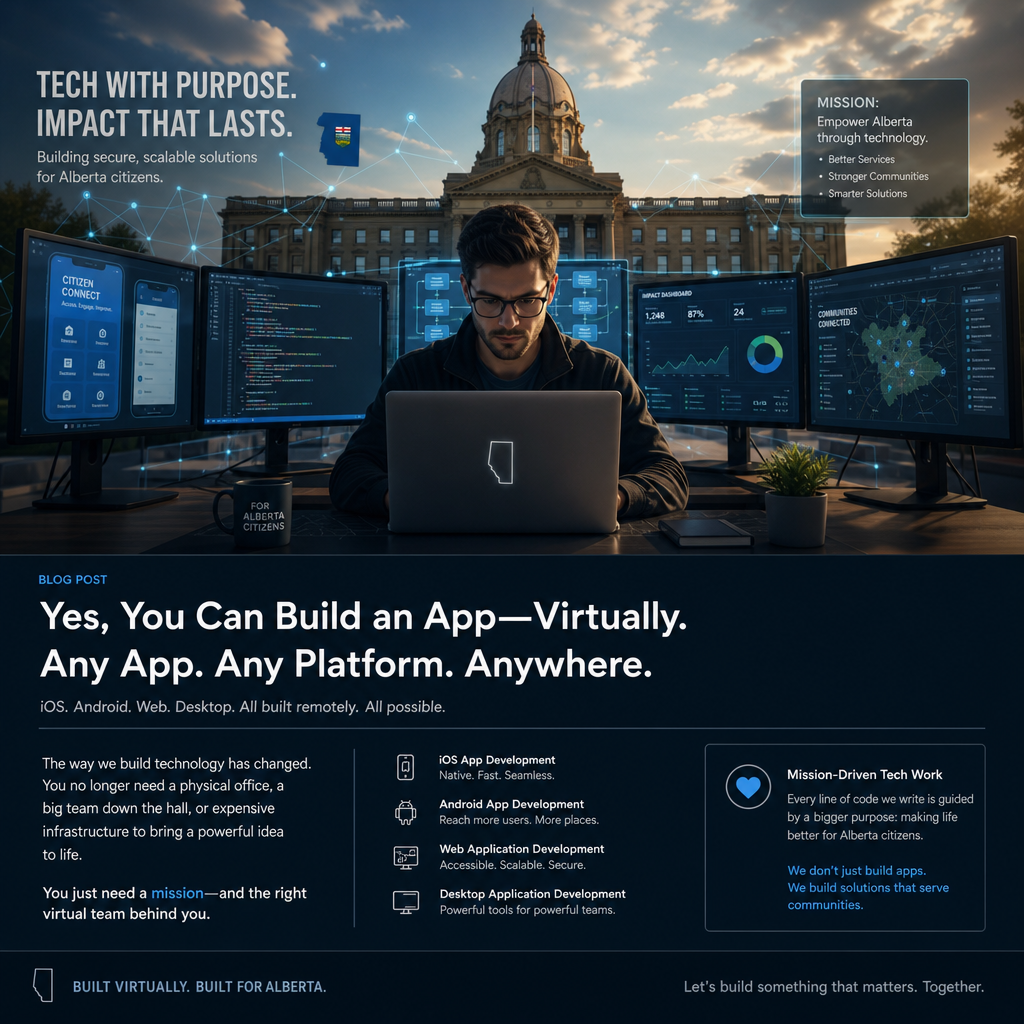
You can do it from your home, your shop, or even the Legislature grounds — just like the image you asked for.
5. The Mission Matters More Than the Location
The real shift is philosophical: software development is no longer tied to geography. You can be one person with a laptop and still build something that reaches thousands. You can be a local advocate and still create tools that influence provincial systems. You can be a developer in Alberta and still ship apps globally.
Virtual development removes barriers. It empowers creators. It levels the playing field.
And it proves something important:
If you have an idea, you can build it — wherever you are.